Dr. King Counts, Minister of Pastoral Care and Counseling
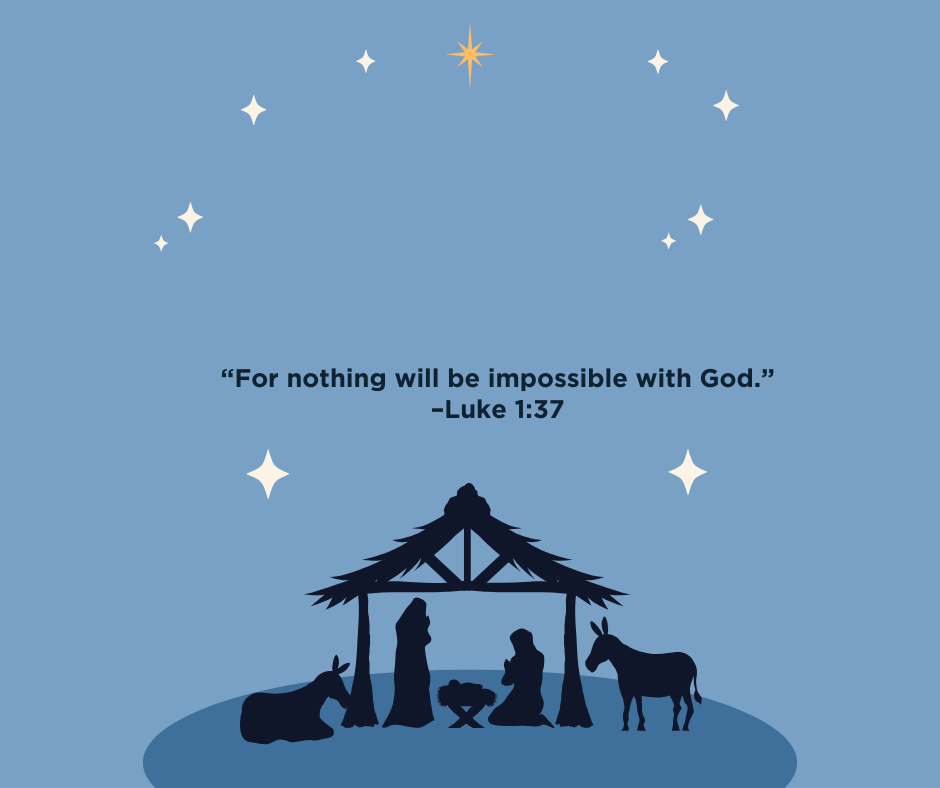
Luke 1:37, the angel Gabriel declares the crux of the matter: “For nothing will be impossible with God.” This single sentence explains the wonder of the virgin birth and reminds us that Christmas is not merely sentimental—it is supernatural.
Luke, the careful physician, records the astonishing announcement: a young girl from an obscure village, Nazareth, will conceive and bear a Son without knowing a man. Gabriel, the messenger who spoke to Daniel and later to Zacharias, now brings news that will change history. This Child will be holy, free from human depravity, and called the Son of God. Mary’s humble response—“Let it be to me according to your word”—shows faith in the face of mystery. The question of how and what finds its answer in Gabriel’s words: “For nothing will be impossible with God.”
This truth is not new. When Sarah laughed at the promise of Isaac, God asked, “Is anything too hard for the LORD?” (Genesis 18:14). Jeremiah prayed, “Ah Lord GOD! You made the heavens and the earth by Your great power… nothing is too hard for You” (Jeremiah 32:17). Even Zacharias doubted the birth of John the Baptist when Gabriel announced it (Luke 1:18). Unbelief has always questioned the supernatural, but God’s answer remains the same: nothing is impossible for Him.
The virgin birth is not optional to Christian faith—it is essential. Those who dismiss it ignore the plain teaching of Scripture and the nature of God Himself. If God is truly God, then He is omnipotent, sovereign, and capable of doing all things. To understand the Bible, we must start here and stay here: “For nothing will be impossible with God.” Without this truth, the gospel collapses.
Consider the wonder of Christ’s birth. Jonathan Edwards once wrote that in Jesus, “infinite highness and infinite condescension meet.” Like the lion and the lamb, whose diverse excellencies combine in one creature, Christ embodies majesty and meekness, strength and sacrifice. The eternal Son took on frail flesh, uniting infinite glory with human weakness. This is the miracle at the heart of Christmas.
The early church confessed this mystery in the Athanasian Creed: Christ is “perfect God and perfect man… one Christ, not by conversion of the Godhead into flesh.” How can one Person be both infinite and finite? How can the eternal dwell in time? The answer is the same: “For nothing will be impossible with God.” What men call impossible, God accomplishes with ease.
And because God became man, our hope is secure. Jesus’ incarnation guarantees our resurrection. As He said in Matthew 19:26, “With men this is impossible, but with God all things are possible.” The Child born in Bethlehem ensures that redeemed saints will one day rise in incorruption to live forever with Him. Christmas is not just about a manger—it also points to an empty tomb and a coming kingdom.
So, what does this mean for us today? Life is full of troubles, but we serve a God who can do more than we ask or think. The crux of Christmas is the crux of our faith: the God who spoke worlds into existence entered our world to redeem us. He is unlimited, amazing, sovereign, and glorious. This season, let us rejoice in the God for whom nothing is impossible.